How can we influence humanity to arrive at the next evolutionary stage of mankind?
Aspects to engineering
Cloning
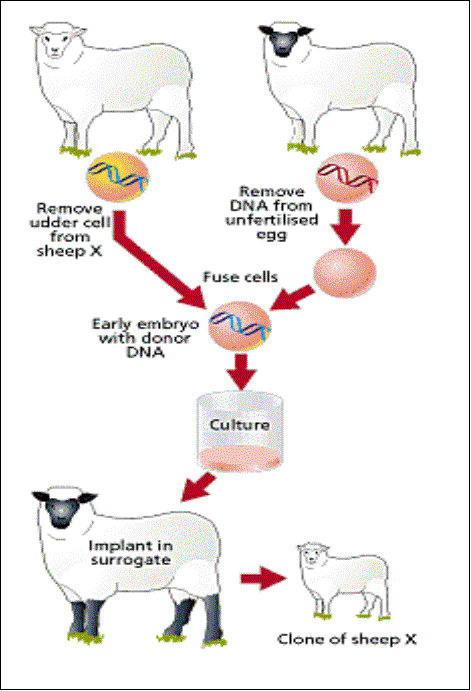
Scientists have previously conducted cloning experiments on sheep in 1996, which proved that cloning mammals was possible, but also demonstrated that it would be very unsafe to try it on humans. To begin with, the research team that produced the sheep (Dolly) had taken 277 attempts before they achieved one successful pregnancy.
Through the years after, the success rate only had minor improvement. Unlike most sheep that are kept in ideal conditions live between the years of 11 and 16, dolly was killed humanely when she was only six years old because she had developed disorders that are normally found in an older sheep.
One reason that scientists gave to explain Dolly ill health was that cell used to clone her had been taken from an adult animal and had somehow 'remembered' its age. This meant that when Dolly was born, her cells thought she was already six years old.
Throughout an animal's life its cells pick up genetic errors, so it's quite possible that Dolly had started life with an error-filled cell.
From this information we can come to the conclusion that cloning may not be the answer to reaching the next evolutionary stage.
Gene therapy
Inheritable diseases for example Aspergers syndrome, Cystic fibrosis and Down syndrome occur because one of the body's own systems is not working properly due to genetic faults which have been passed down from previous generations.
The reason for this is that one or more of the body's genes carries faulty information. At the moment there is currently around 4,500 different diseases that occur when just one gene is damaged.
Gene therapy is the introduction of healthy genes into cells in the place of missing or defective ones in order to correct genetic disorders such as the aforementioned ones.
At this stage, gene therapy is a functional method of genetic engineering which has played a major part in the lives of some humans affected by inheritable disease. Gene therapy will continue to be crucial in our development as human beings especially as we work to eradicate inheritable disease altogether.
Choosing between embryos
Every month scientists develop more genetic tests so they are able to tell if people are likely to suffer from a specific disease due to their genetics. When people discover that they have one of these faulty genes, they are faced with a number of choices.
In some cases they may look for treatment that makes the disease less severe or damaging, or possibly in other cases they can alter their lifestyle.
One decision they have to make is whether or not to have children. If a person's genetic history indicates occasional faulty genes resulting in disease, there is a possibility that he or she could pass this on to their children if they had any. Many people want to have children, but do not want to pass on potential diseases.
Through IVF, prospective parents are able to screen their embryos and select one which is rid of all evidence of a genetic disease down the track. Although this process seems like a win for everyone, some people have ethical issues with this.
The more we select specific components (for example which embryo to use) and interfere with the birth of children, the more the question of 'at what point does the child become a product of science, and not a product of its parents?' is posed.
Ethicality aside, embryo selection could continue to be a vital aspect in minimising genetic disease. Although it won't necessarily 'improve' us, it can prevent the health of humans from declining.