How can we influence humanity to arrive at the next evolutionary stage of mankind?
DNA: What actually is it?
The molecule DNA (Deoxyribonucleic Acid) is a recipe or blueprint that determines everything from one's physical attributes to their intellectual capability.
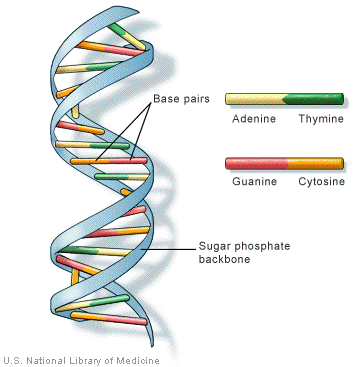
An individual strand of DNA or a chromosome is made up of phosphate, a nitrogen base and sugar. Chromosomes are ladder-like structures where the vertical rails are made up of alternating phosphate and sugar molecules. The horizontal 'steps' are called genes. This spiral structure is known as a double-helix and can be seen below.
A portion of a cell's DNA is called a gene. Genes contain information for a cell to read and use. These genes are made up of combinations of 4 nitrogen bases which go by the names of Adenine (A), thymine (T), guanine (G) and cytosine (C).
Source: www.prtaylor.gatech.edu/
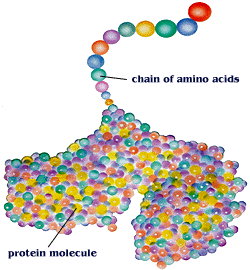
The code/order in which these nitrogen bases is organised determines what instructions the gene gives. These instructions given by genes tell amino acids how to connect up, which form proteins once connected. The length and sequence of the gene determines the size and shape of the protein. The size and shape of the protein determines what function it plays in the body, with these functions ranging from our physical appearance to our mental capacity and everything inbetween.
Source: www.nobelprize.org/
Different gene combinations create different appearances. This is How DNA and also the little sections of DNA called genes determine what we look like and how we think.
This video is an excellent explanation of DNA

As labeled, this diagram shows a nucleus, chromosome and gene.
Source: BBC GCSE Bitesize
A portion of a DNA double-helix.
Source: chemguide.co.uk

There are 21 different amino acids which can connect in different combinations resulting in the production of many different proteins. Proteins play many different roles in the functionality of the body.
As displayed in the diagram to the left, each coloured 'step' (gene) of the 'ladder' represents a nitrogen base. For example we can see the yellow genes represent A (Adenine) and that the green genes represent T (Thymine).